

Case Study 03: personal development is a group project
An intro to "Full Circle" feat. Kayla's notes on Carl Jung, friendship, desire, and attention.

Last week, I shared on my personal substack, terms & conditions, a relationship reflection guide called “Full Circle”, for anyone who wants to reflect on how they’re becoming, through the people closest to them.
This week, I wanted to explain the psychology behind its design — because it’s not just reflection.
Before I get started, and for those who are new to Hauswarm’s substack, here’s a quick recap (and a warning, depending on your tolerance for psychology) of my background: I’m a social psychologist and PhD researcher in human-centered computing (Harvard → LSE → consulting → GA Tech), and I design with a heavy psychological/philosophical lens. In fact, one of my favorite papers written by my MSc thesis advisor is about Malcolm X and his autobiography as a form of identity development. So, naturally, Full Circle is doing more than it looks like it’s doing.
Full Circle reads like a friendship reflection guide, but it’s also a tool for perceiving your life from a new angle. It’s meant to be a very concentrated way to make your desires more legible, reveal the relational patterns you’ve been rehearsing all year, and get honest about what your current relationships are sneakily encouraging (or discouraging) in you. Goals show up here, but mostly as a device to focus your attention as you reflect on a topic that could otherwise get overwhelming. Let’s jump in.
Oh yeah, one more thing: a short detour through Jung (plus a riff on Henrik Karlsson’s co-evolutionary loops). Then I’ll map those ideas onto Full Circle and show how it’s built from the same DNA as the rest of Hauswarm!
My Carl Jung Renaissance: Why your personal evolution is my personal evolution
I typically read a few books at a time, and all of the ones I’m reading (Slow Productivity by Cal Newport, Highly Sensitive Person by Elaine Aron, Man’s Search for Meaning by Viktor Frankl) mention Jung in some form (as an aside: I’m now convinced that if you’re reading a self-help book that doesn’t reference Jung, you’re most likely being played). I bring him up here because the more I learn about his approach to human psychology, the more I understand why conversations I’ve designed in the past worked and what aspects of them were less crucial to the conversation being personally transformative to guests.
Dr. Jung’s idea of “Projection”
Carl Jung understood that you cannot know yourself without other people. We quite literally cannot access certain parts of ourselves without the right people around us to give us access. Jung called this “projection” — when we see someone doing something we find fascinating or inspiring or repulsive, we are seeing aspects of ourselves that we haven’t yet noticed, claimed, or integrated.
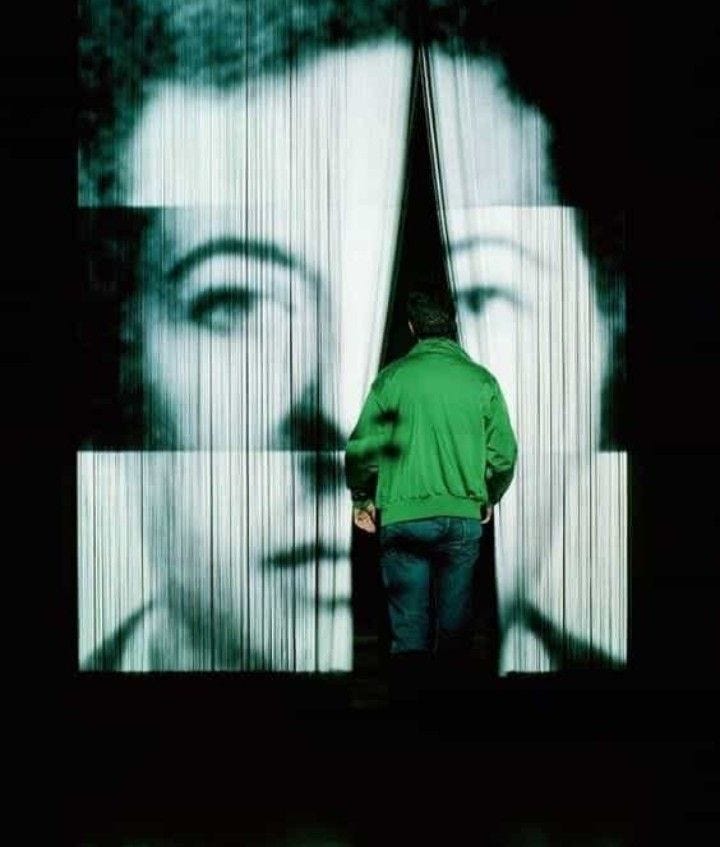
Their existence is evidence that some part of you that you have suppressed is legitimate. The example I mention in the Full Circle post is my freshman roommates at Harvard, both artists, who catalyzed my switch from pre-med to anthropology and social psychology. I saw my dormant creative desires reflected at me through people I admired and observed up close. Every meal we shared together gave me a chance to safely become less of a non-enthusiastic aspiring doctor and more of I am today.
Participation Mystique
Jung also talked about participation mystique, a term he borrowed from anthropologist Lucien Lévy-Bruhenl. It describes how we unconsciously merge with the people around us. Not metaphorically. Actually merge. The psychic boundaries between self and other dissolve.
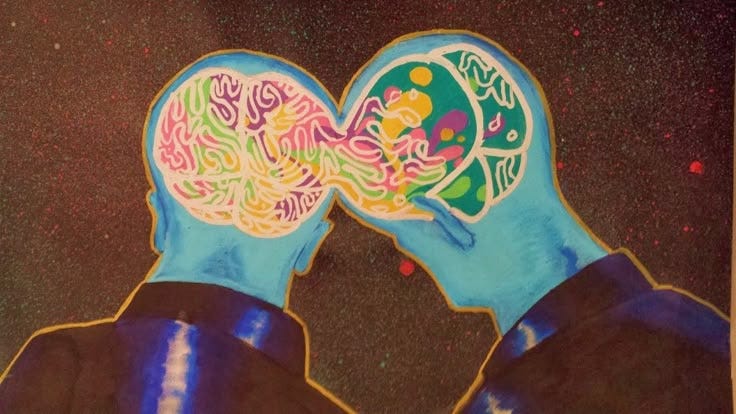
You don’t consciously decide “I’m going to adopt my friend’s values now.” But you will find yourself randomly thinking their thoughts, wanting what they want, fearing things they’ve said they fear. You’ve entered a state of unconscious fusion with your friends. This is obviously even more the case for a romantic partner.
This happened to me in London. Being my friends’ +1 at members’ clubs around the city didn’t just expose me to new aesthetics. I entered a participation mystique with that entire social world. I absorbed its sensibilities, its rhythms, its visual language so deeply that years later they emerged as Hauswarm’s aesthetic DNA. I wasn’t copying or imitating. I had genuinely merged.
Henrik Karlsson writes beautifully about this! In his essay on co-evolutionary loops in relationships, he describes how people in close proximity don’t just shape each other in linear ways (where A shapes B, then B shapes A). We also create feedback loops where each person’s becoming shapes the other’s becoming, which shapes the first person’s becoming, and so on.
This is why Jung believed that individuation (his term for becoming fully yourself, integrating all the disparate parts of your psyche) can’t happen alone. You need other people as mirrors, to expose different potential ways of becoming, and each of your becoming facilitates the others’.
Becoming who You are is fundamentally relational!
Part II: Bringing it back to Full Circle
The Full Circle activity has four parts, each of which helps us notice what parts of ourselves, and of our friends, we are projecting or reflecting.
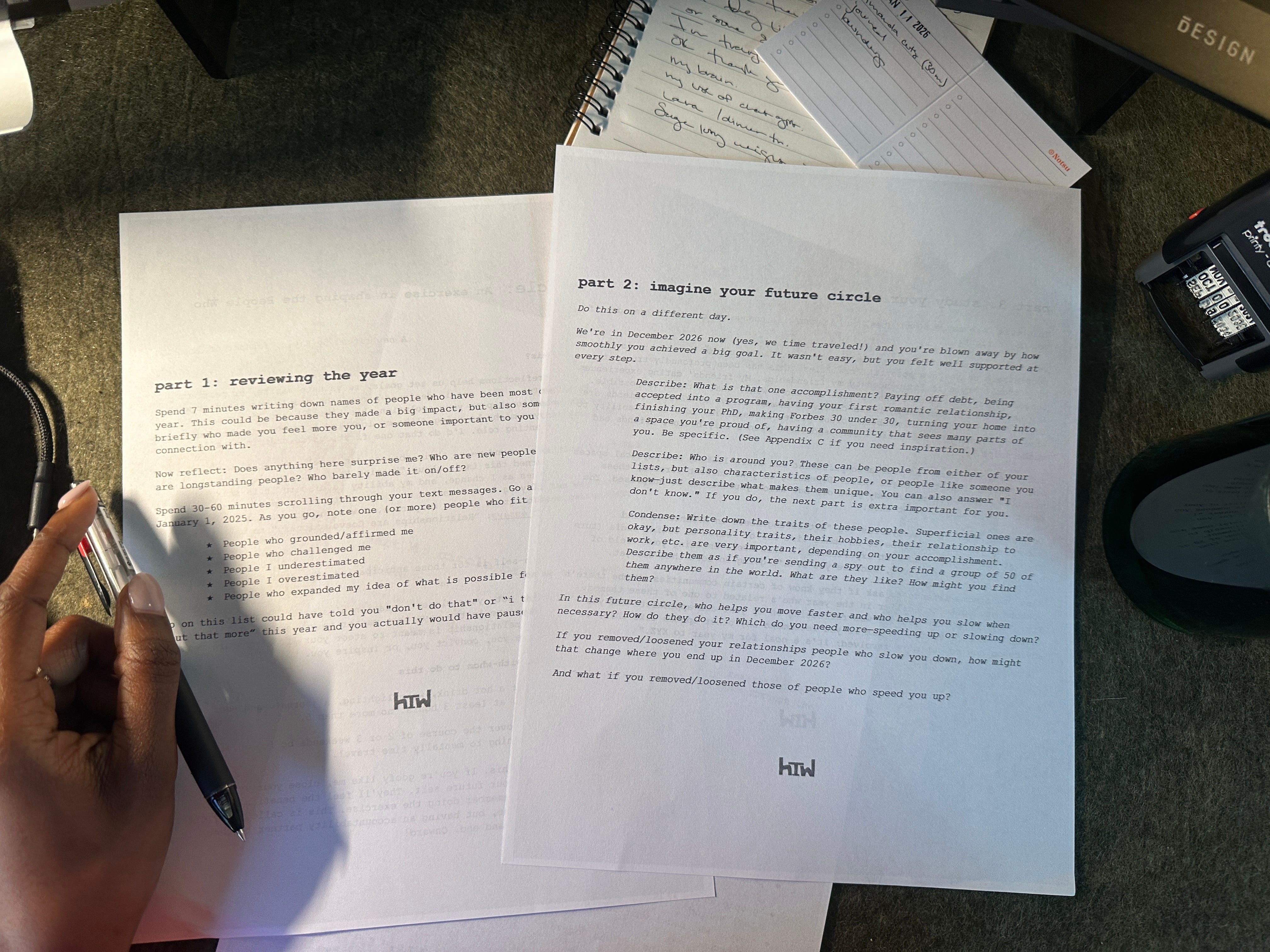
The first part asks you to list the people who actually had weight in your year, and then to scroll through your texts and notice who grounded you, challenged you, and expanded what felt possible. Yes, this is definitely a memory-jogging exercise, but it’s my way of helping us see the mini-universe of relationships we’ve been living in. It also surfaces a few subtler realities about your circle: invitations you didn’t have capacity to answer, relationships you’ve been avoiding, and places where you overestimated or underestimated someone (in care, in steadiness, in need, in independence).
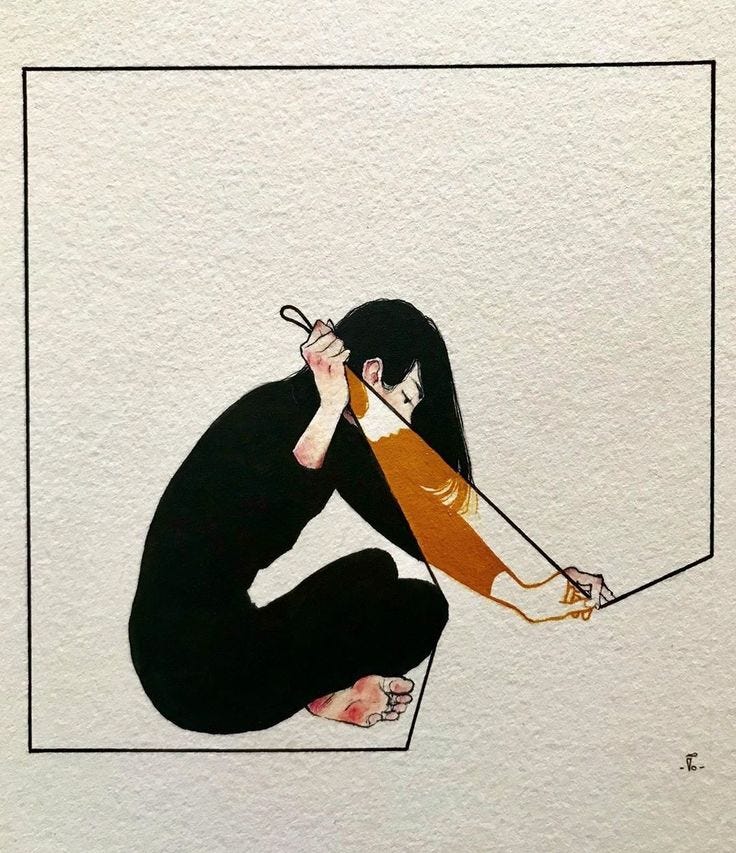
The second part asks you to imagine your future circle. I use one “future snapshot” as a focusing tool, so the goal isn’t to focus on an achievement, but the social atmosphere around it — what kinds of people you see, what kinds of conversations you picture, what kinds of support you assume is available when you get there. Also — I don’t ask you to do this directly — but I hope that this also encourages you to think about the relationships or spaces in your life in which these traits do not exist (do you spend a lot of time there? why? is it possible to spend less time there? if not, how can you bring people from your future circle into other parts of your life?).
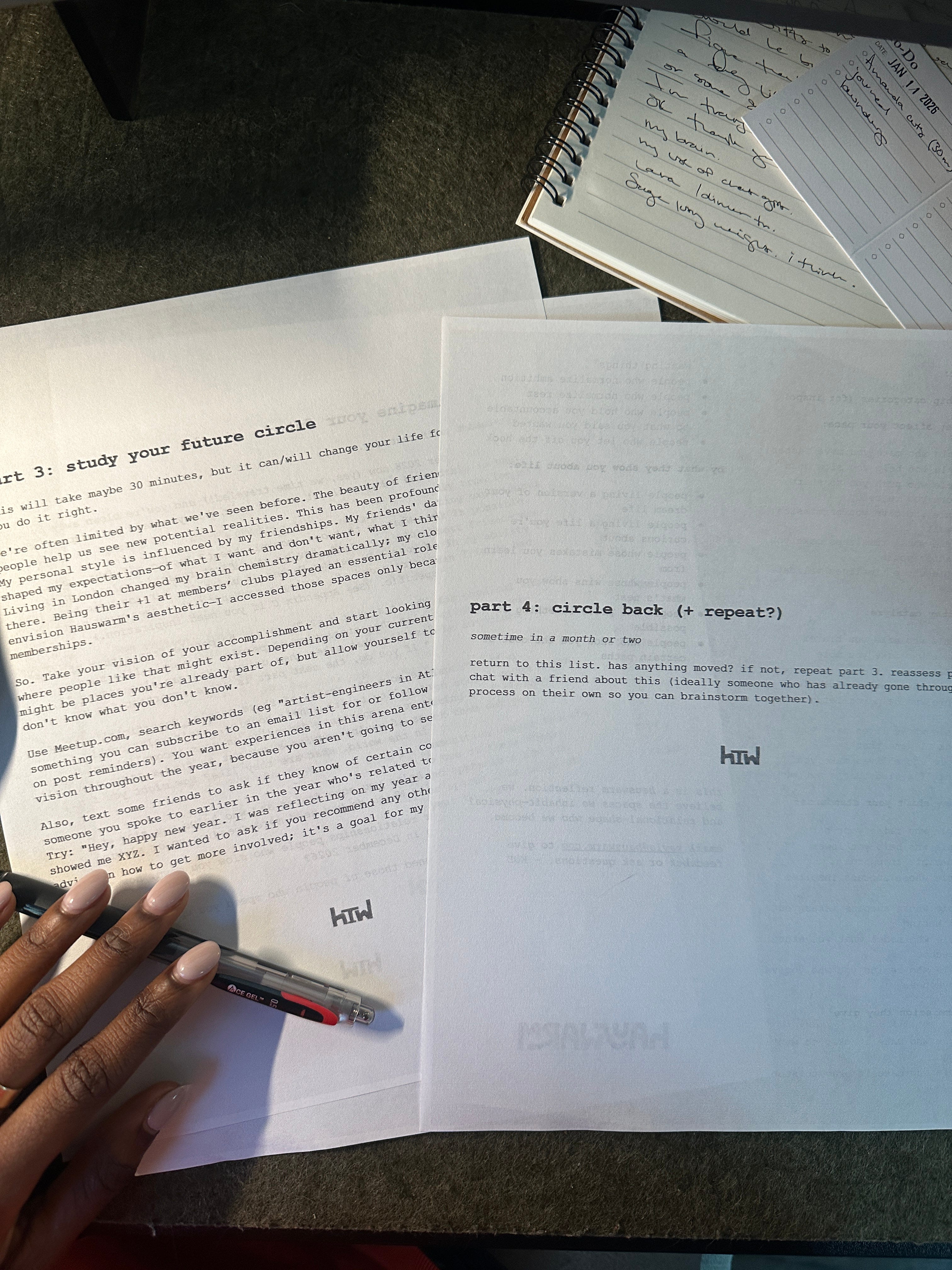
The third asks you to identify spaces (IRL, on the internet, in your workplace, etc.) that has people you think embody those characteristics you listed in the second part and then take the very first step toward integrating yourself into those communities, or committing more to one you’re already a part of or you know friends are a part of. For me, this is where forgiveness becomes logical: I was asking myself to become someone new while living inside a social atmosphere that kept pulling me back into old rhythms I’m not dancing to anymore.
Part III: Why Full Circle has the same DNA as everything I design at Hauswarm
Because this is a “case study” post, it’s important that I explain how Full Circle is aligned with Hauswarm’s methodology across the board. Whether I’m creating a reflection guide like this one, or facilitating an event with fifty people, I am always designing for one thing: creating conditions where people notice parts of themselves and each other that were not accessible before they entered the room.
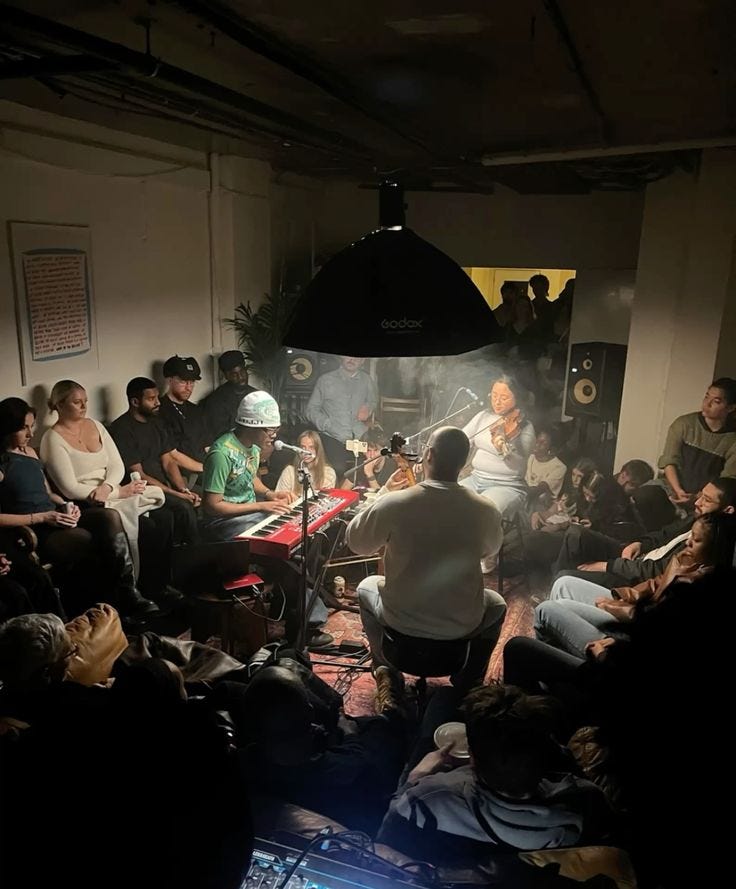
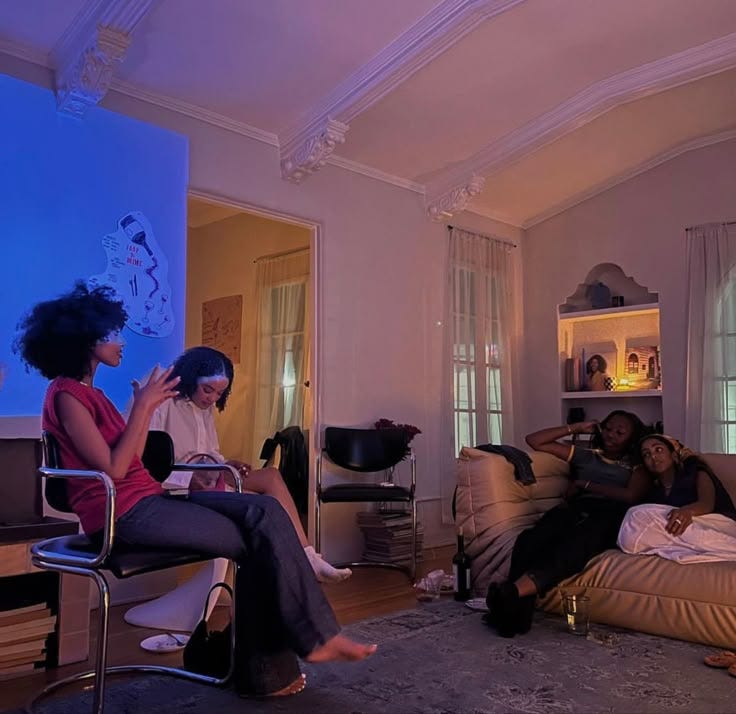
For our in-person conversations, this shows up in how we do everything: physical space design, guest arrival experience, how we manage the schedule, and the way we help clients curate the guest list. Our goal is to bring people who are complementary: similar enough for the space to feel recognizable, different enough to not default to old thinking patterns. It’s incredibly important to us that each guest can see themselves reflected by the group, but also see themselves in other guests, in ways they didn’t expect.
Full Circle works on the same principle, just in a different format. When you’re scrolling through your texts and noting who grounded you, challenged you, expanded you... you’re doing something most people never do. You’re zooming out to see all of the conversations you’ve been having throughout the year, relative to each other. Usually we experience each relationship in isolation, one conversation at a time. But when you map them all out together, you start to see patterns. You notice where you’ve been melding with people, where different relationships activate different parts of you, where you might want more of certain dynamics and less of others.
And just like in our facilitated conversations where we build in time for individual reflection and integration, Full Circle asks you to come back to it after you’ve sat with it for a bit. This lets you go back to living your life with a new sense of discernment and sensitivity - noticing whether the relationships you’re investing in are the ones that help you tell the truth about what you want, and then live in a way that makes that wanting possible.
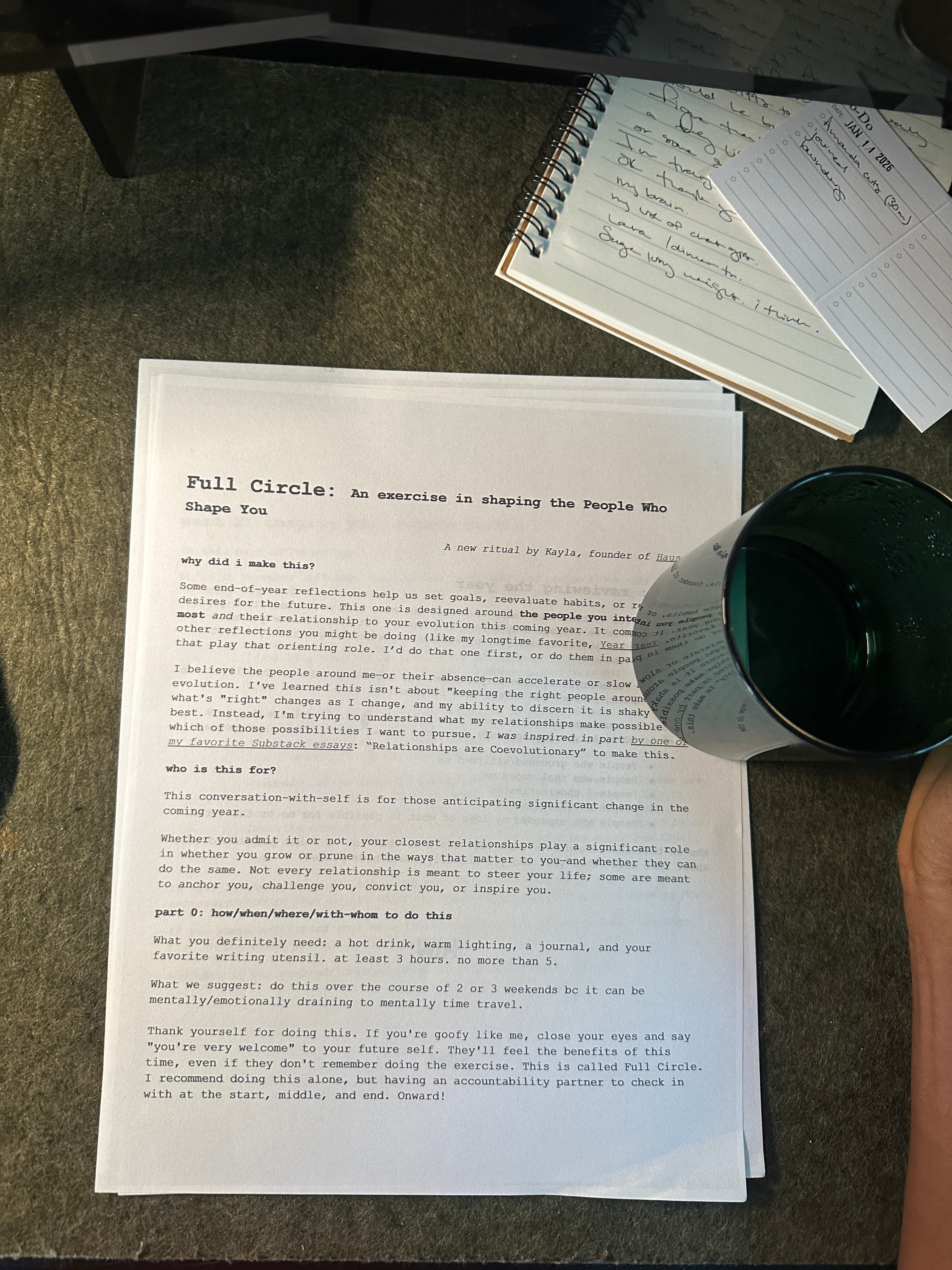
If you want to try it out, the Full Circle guide is here, as a public link on Google Drive.
And if you’re curious about how we might bring this kind of conversational design into your organization or community, I’d love to hear from you at kayla@hauswarm.com.